Project Summary
This project demonstrates a network-based attack simulation where a staged Meterpreter reverse shell payload (update.exe) is delivered from a Kali Linux attacker to a Windows 10 victim via HTTP. Detection is achieved through Sysmon endpoint telemetry forwarded to Wazuh SIEM, with additional network-layer detection via Suricata IDS.
Overview
This lab simulates a full attack chain — from payload generation to post-exploitation reconnaissance — and validates detection across three layers: EDR (Sysmon), SIEM (Wazuh), and IDS (Suricata).
The objective was to demonstrate that multi-layer detection significantly increases confidence when investigating a compromise.
Lab Environment
| Role | OS | IP | Tools |
|---|---|---|---|
| Attacker | Kali Linux (VM) | 192.168.0.244 | Metasploit 6.4.56, msfvenom |
| Victim | Windows 10 (VM) | 192.168.0.29 | Sysmon v15, Wazuh Agent 004 |
| SIEM / IDS | Ubuntu Server (VM) | — | Wazuh 4.x, Suricata |
Network: Isolated lab environment. Microsoft Defender disabled on victim for simulation purposes.
Attack Chain
- Payload generation — msfvenom creates
update.exe(windows/x64/meterpreter/reverse_tcp) - Delivery — Python HTTP server serves payload; victim downloads via browser
- Execution — victim runs
update.exe; Meterpreter session opens on port 4444 - Reconnaissance — attacker runs
whoami,ipconfig,net user,net localgroup administrators
Detection Results
Sysmon Event ID 1 — Process Creation
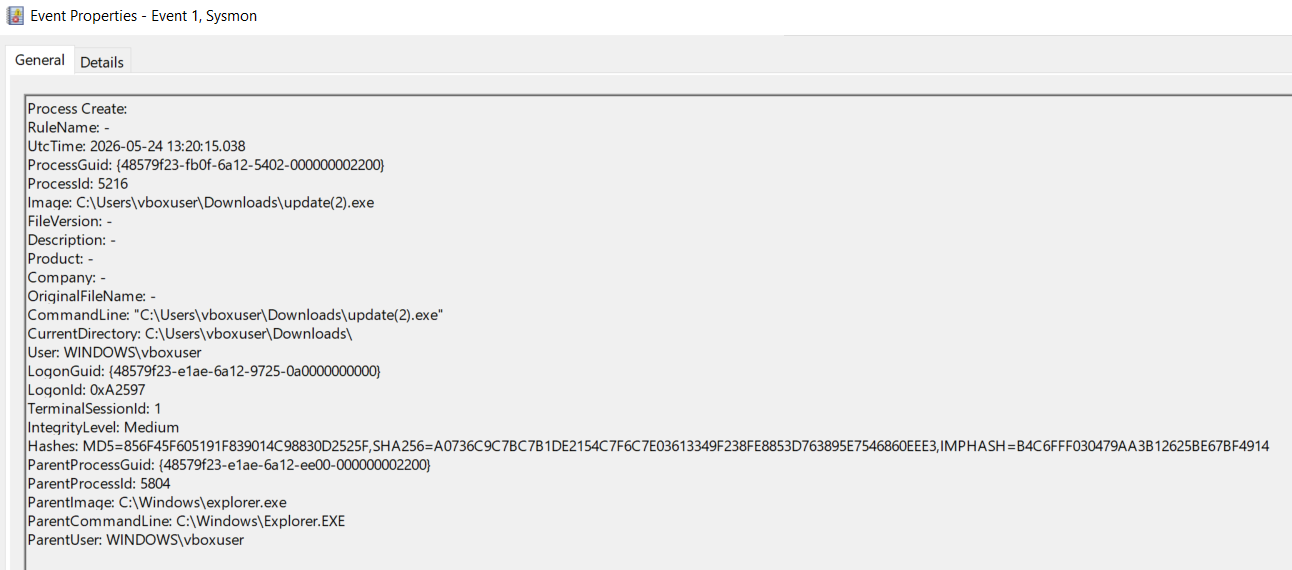
update(2).exe spawned from explorer.exe with no file metadata (no FileVersion, Company, Description). Unsigned binary — MD5: 856F45F605191F839014C98830D2525F
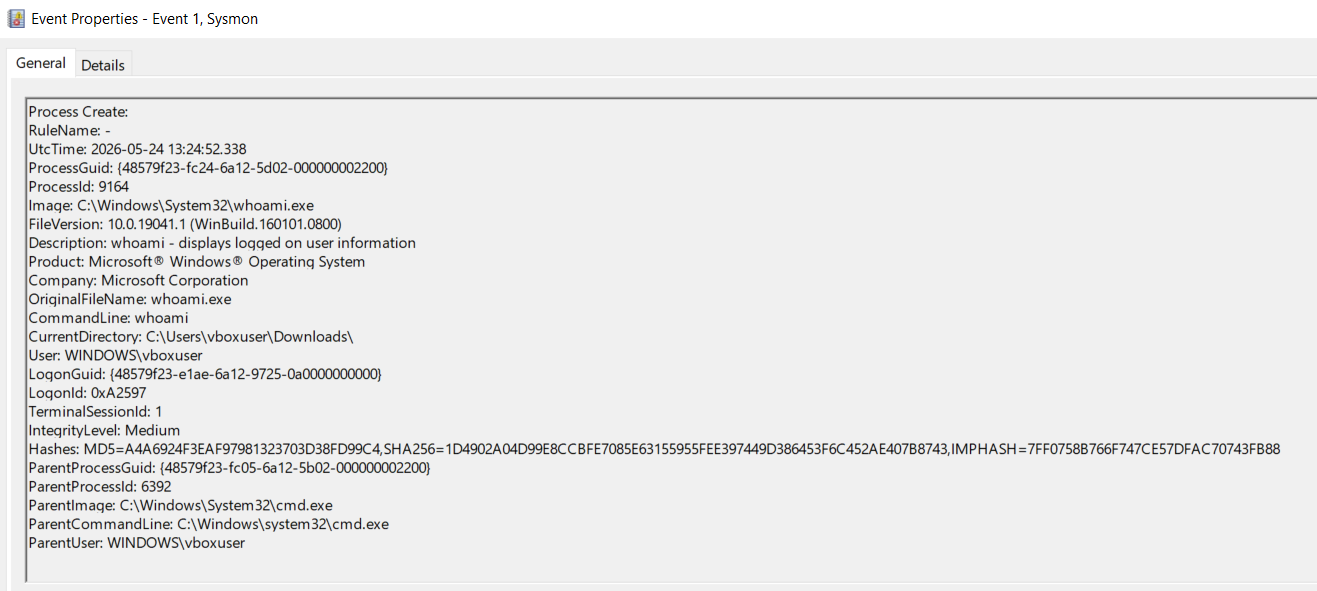
whoami.exe spawned from cmd.exe inside the Downloads directory — post-exploitation recon pattern.
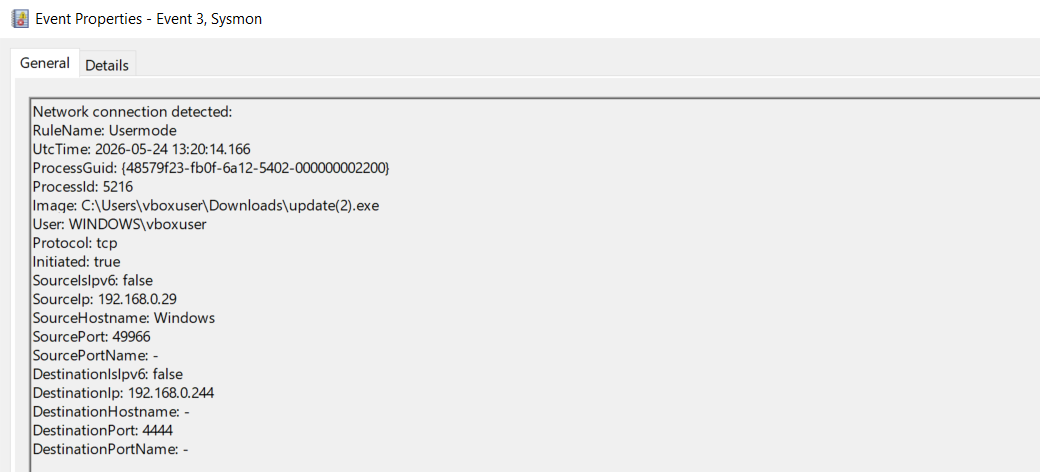
Sysmon Event ID 3 — Network Connection (C2)
update(2).exe initiated outbound TCP connection to 192.168.0.244:4444.
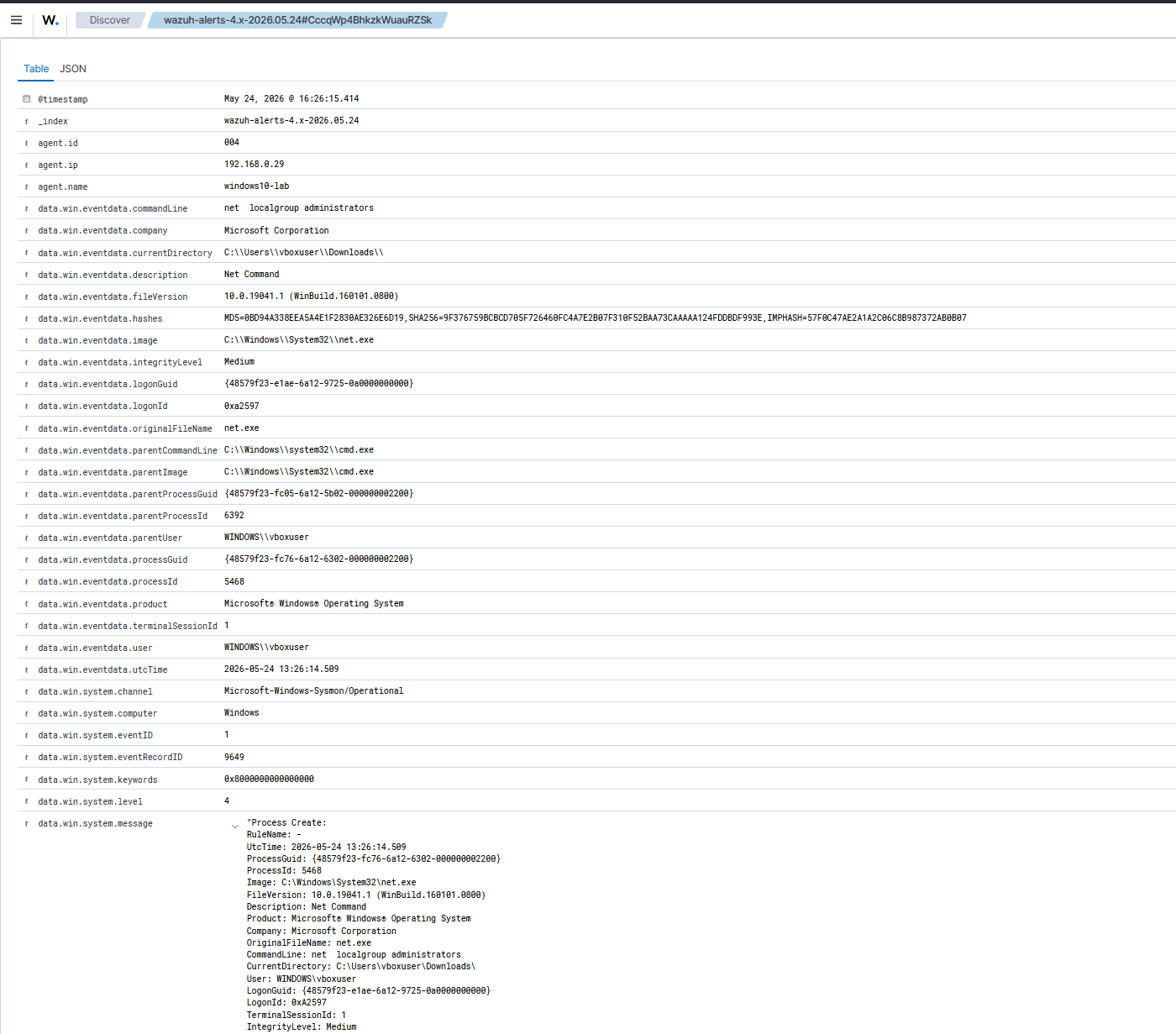
Wazuh — Account Discovery Alert (T1087)
The net localgroup administrators command triggered Wazuh Rule 92031. Four alerts fired in rapid succession for Account Discovery activity from agent windows10-lab.

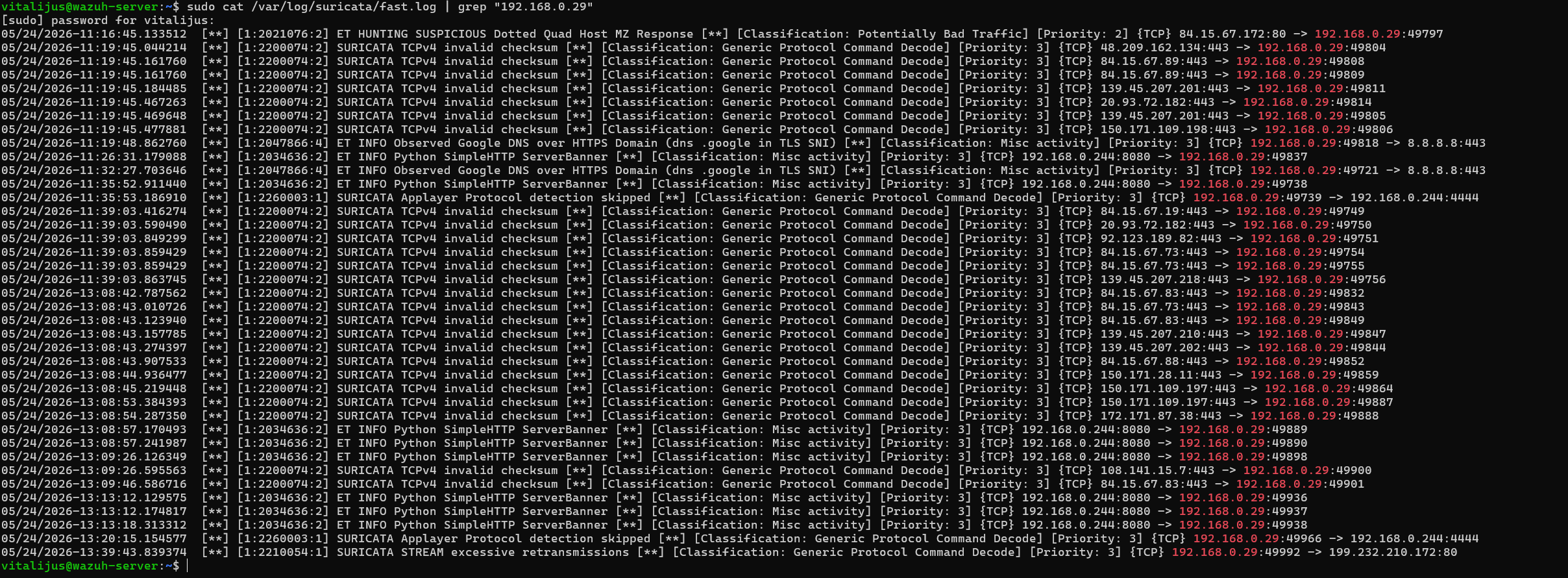
Suricata — Network-Layer Detection
Suricata fast.log captured three key signatures:
- ET HUNTING SUSPICIOUS Dotted Quad Host MZ Response — EXE file downloaded over HTTP
- ET INFO Python SimpleHTTP ServerBanner — attacker’s delivery server identified
- SURICATA Applayer Protocol detection skipped — unknown protocol on port 4444 (C2 channel)
MITRE ATT&CK Techniques Observed
| Technique ID | Name |
|---|---|
| T1059.003 | Command and Scripting Interpreter: Windows Command Shell |
| T1087 | Account Discovery — Wazuh Rule 92031, 4 alerts |
| T1105 | Ingress Tool Transfer — payload via Python HTTP server |
| T1571 | Non-Standard Port — C2 on port 4444 |
| T1562.001 | Impair Defenses — Defender disabled |
Key Findings
- A staged Meterpreter reverse shell was successfully delivered and executed on the victim machine.
- Sysmon EID 1 identified the malicious binary by the absence of file metadata — a reliable IOC for unsigned payloads.
- Sysmon EID 3 confirmed the C2 connection with full source/destination detail.
- Wazuh fired 4 alerts for post-exploitation reconnaissance (T1087).
- Suricata independently confirmed payload delivery and C2 communication at the network layer.
- Key lesson: no single tool caught everything — multi-layer detection (EDR + SIEM + IDS) is essential.